sensors vs actuators….

Difference Between Sensors and Actuators
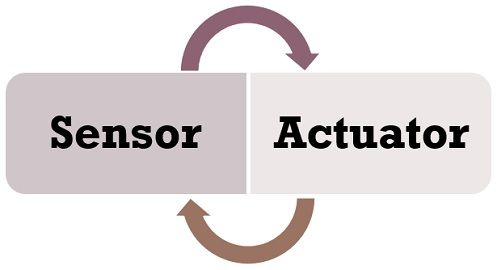
Sensor vs Actuator

Sensors and Actuators are essential elements of the embedded systems. These are used in several real-life applications such as flight control system in an aircraft, process control systems in nuclear reactors, power plants that require to be operated on an automated control. Sensors and Actuators mainly differ by the purpose both provide, the sensor is used to monitor the changes in the environment by using measurands while the actuator is used when along with monitoring the control is also applied such as to control the physical change.

These devices act as the mediator between the physical environment and the electronic system where the sensor and actuator are embedded.

Content: Sensors and Actuators

  1. Comparison Chart
  2. Definition
  3. Key Differences
  4. Conclusion

Comparison Chart

BASIS FOR COMPARISONSENSORSACTUATORSBasicUsed to measure the continuous and discrete process variables.Impel continuous and discrete processes parameters.Placed atInput portOutput portOutcomeElectrical signalHeat or motionExampleMagnetometer, Cameras, Accelerometer, microphones.LED, Laser, Loudspeaker, Solenoid, motor controllers.

Definition of Sensors

sensor is an electronic instrument that is able to measure the physical quantity and generate a considerate output. These output of the sensors are usually in the form of electrical signals. Let’s understand with an example, suppose we need to control the speed of our vehicle and for that purpose, we are designing a control system for it. It could not be possible by just fixing the fuel throttle, it needs to be adjusted at it each moment when the speed changes (such as in the uphill and downhill). 

actuators: Introduction…

What is an actuator?

An actuator is a cleaner and more efficient alternative to hydraulic and pneumatic solutions. Electric actuators convert rotary motion of gears and a ball or lead screw into straight, or linear, motion for accurate, repeatable performance of pushing/pulling, raising/lowering, rotating or positioning loads.

Actuators are commonly used in applications such as agricultural machines and equipment, medical devices, factory automation, material handling and many others.

Find out more about electric actuators >

What are the different types of actuators?

Thomson offers a wide range that are categorized as linear, precision, stepper motor and rodless.

  • Linear actuators are used in all types of equipment to automate processes, remove people from dangerous situations, provide remote control or make difficult/tedious/manual jobs easier.
  • Precision linear actuators are designed for applications that require higher speed, higher loads, continuous duty cycle, precise positioning and flexible integration in tight areas.
  • Stepper motor linear actuators combine a hybrid stepper motor and a precision lead screw in one compact envelope, suiting applications where external guidance is present or a high level of design flexibility required.
  • Rodless linear actuators are also known as linear motion systems.

Sensors; Introduction to sensors….

In the broadest definition, a sensor is a device, module, machine, or subsystem whose purpose is to detect events or changes in its environment and send the information to other electronics, frequently a computer processor. A sensor is always used with other electronics.

Sensors are used in everyday objects such as touch-sensitive elevator buttons (tactile sensor) and lamps which dim or brighten by touching the base, besides innumerable applications of which most people are never aware. With advances in micromachinery and easy-to-use microcontroller platforms, the uses of sensors have expanded beyond the traditional fields of temperature, pressure or flow measurement,[1] for example into MARG sensors. Moreover, analog sensors such as potentiometers and force-sensing resistors are still widely used. Applications include manufacturing and machinery, airplanes and aerospace, cars, medicine, robotics and many other aspects of our day-to-day life. There are a wide range of other sensors, measuring chemical & physical properties of materials. A few examples include optical sensors for Refractive index measurement, vibrational sensors for fluid viscosity measurement and electro-chemical sensor for monitoring pH of fluids.

A sensor’s sensitivity indicates how much the sensor’s output changes when the input quantity being measured changes. For instance, if the mercury in a thermometer moves 1  cm when the temperature changes by 1 °C, the sensitivity is 1 cm/°C (it is basically the slope dy/dx assuming a linear characteristic). Some sensors can also affect what they measure; for instance, a room temperature thermometer inserted into a hot cup of liquid cools the liquid while the liquid heats the thermometer. Sensors are usually designed to have a small effect on what is measured; making the sensor smaller often improves this and may introduce other advantages.[2]